In the early days of its existence, the borough had law enforcement officers who held the title of Marshal. The very first person to hold the title of Marshal was Peter A. Zisgen, who was appointed by the borough council in 1913. In those times, the Marshal earned a mere $2.25 salary for a 12-hour workday.
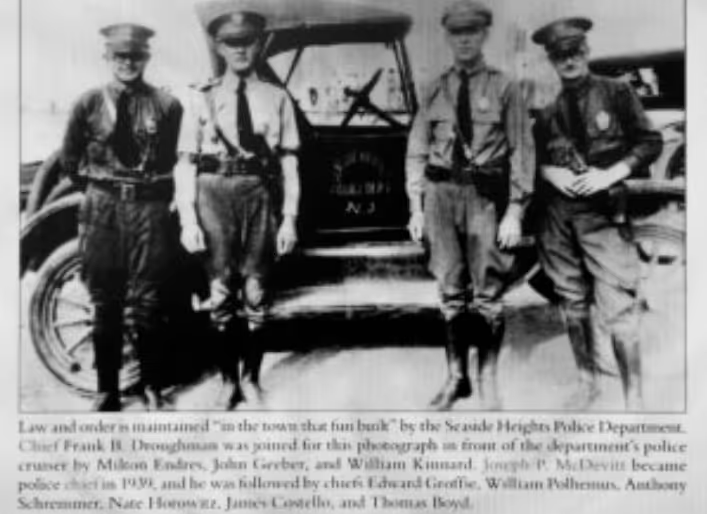
The first known Chief of Police was Frank B. Droughman, who was appointed sometime between 1913 and 1915. It is believed that his career lasted until approximately 1939.
In 1935, Joseph P. McDevitt was appointed as a Marshal with the Seaside Heights Police Department. Four years later, McDevitt was appointed as the second Chief of Police by Mayor J. Stanley Tunney.
In 1944, the police department was formally established by ordinance and organized under the New Jersey Civil Service Commission. Edward J. Ryan was named Lieutenant, and John J. Bellange was named Sergeant to serve under Chief McDevitt. The department was staffed by 12 officers year-round, with the force expanding to 30 officers to handle the busy summer season. In addition to regular police duties, the department also handled parking meter and traffic regulation operations, as it continues to do today.
The police department was well equipped for the time period, with patrol cars linked by two-way radio contact and other devices necessary to handle the problems that arise when dealing with a large and sometimes volatile summer population.
Of all its fine equipment, the department took the most pride in the closed-circuit television monitoring system. Other municipalities used television, but the Seaside Heights system was unique, providing virtually complete scanning of the entire community from a fixed point. It made it possible for a single police officer sitting at a console at headquarters to maintain visual contact with any location in town using a minimum of manpower.
Chief McDevitt spoke before the House of Representatives in 1965 regarding the escalating drug problem among youth and prescription medications. The following is an excerpt from the Congressional Record – House of Representatives, Volume 111, page 703:
The White House, January 27, 1965. CONTROL OF DANGEROUS DRUGS…
A legislative assault on the “goof ball” and the “pep pill” may well become the new Congress’ very first contribution to the Great Society… For one view of the pill problem, listen to Police Chief Joseph P. McDevitt of Seaside Heights, N.J. Since 1960, he says, disorderly conduct arrests in that resort town have grown almost fivefold. “At first we thought the kids had found an illegal beer tap, but when our cops approached them they’d start biting, kicking, and shoving—things they wouldn’t do on alcohol,” the chief relates. “Then we started noticing other kids with glazed or vacant looks at the dance halls and on the beachfront, and we realized we had a pill problem.” The biggest troublemakers are high schoolers spending spring weekends at the beach. Police once broke up a sex party involving 35 noisy teenagers in a rented cabin. Amid the ripped furniture, police found a large supply of pills.
As the years progressed, the police department expanded its ranks of full-time, year-round officers, and the number of Seasonal Police Officers, as they were first known, increased as well. This expansion was driven by the development of the Borough and the well-advertised vacation image of Seaside Heights, which drew tens of thousands of tourists and vacationers each summer to the boardwalk and beaches. Today, there are 26 full-time, year-round police officers and more than 100 Special Law Enforcement Officers, Class I and Class II.
The Seaside Heights Police Department is well known for the successes of many of its former Seasonal Police Officers and Special Law Enforcement Officers. Throughout the State of New Jersey, as well as the rest of the country, there are thousands of officers who have had successful careers in law enforcement, whether in municipal, county, state, or federal agencies.